
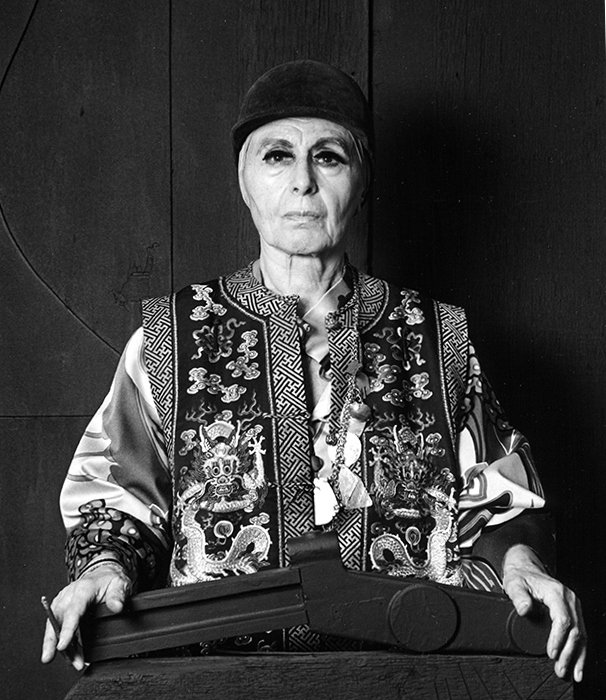
Louise Nevelson (1899–1988)
Born in what is now present-day Ukraine in 1899, Louise Nevelson emigrated to the United States as a young child. When she was just twenty-one years old, she moved to New York City, where she began studying art. She attended classes at the Art Students League of New York, explored museums, and ventured into new mediums, including dance. From the beginning, Nevelson was drawn towards sculpture and abstraction.
Throughout the 1930s, Nevelson participated in group gallery exhibitions and her first solo exhibition in 1941. She experimented with printmaking, painting, and various sculptural mediums, navigating the post-war abstract expressionism that punctuated the New York art scene. The 1940s marked the beginning of Nevelson’s infamous use of wood and found objects that quickly became her signature.
What began as sculptures that gave discarded objects a new life soon developed into full-scale art installations. Nevelson used found wood amidst New York City, assembling monochromatic sculptures that explored space and the concept of light and shadow. Each of her sculptures is an exploration of the repurposing of parts and giving them new life. Nevelson was primarily drawn to the color black, claiming that, in her mind, it contains all colors within itself, symbolizing the depth and complexity explored in her work.
Her works continue to carry weight and influence, even today, as they live within the permanent collections of museums such as the Whitney, the Metropolitan Museum of Art, and the MoMA.
“My work is delicate; it may look strong, but it is delicate. True strength is delicate. My whole life is in it.’ – Louise Nevelson.