
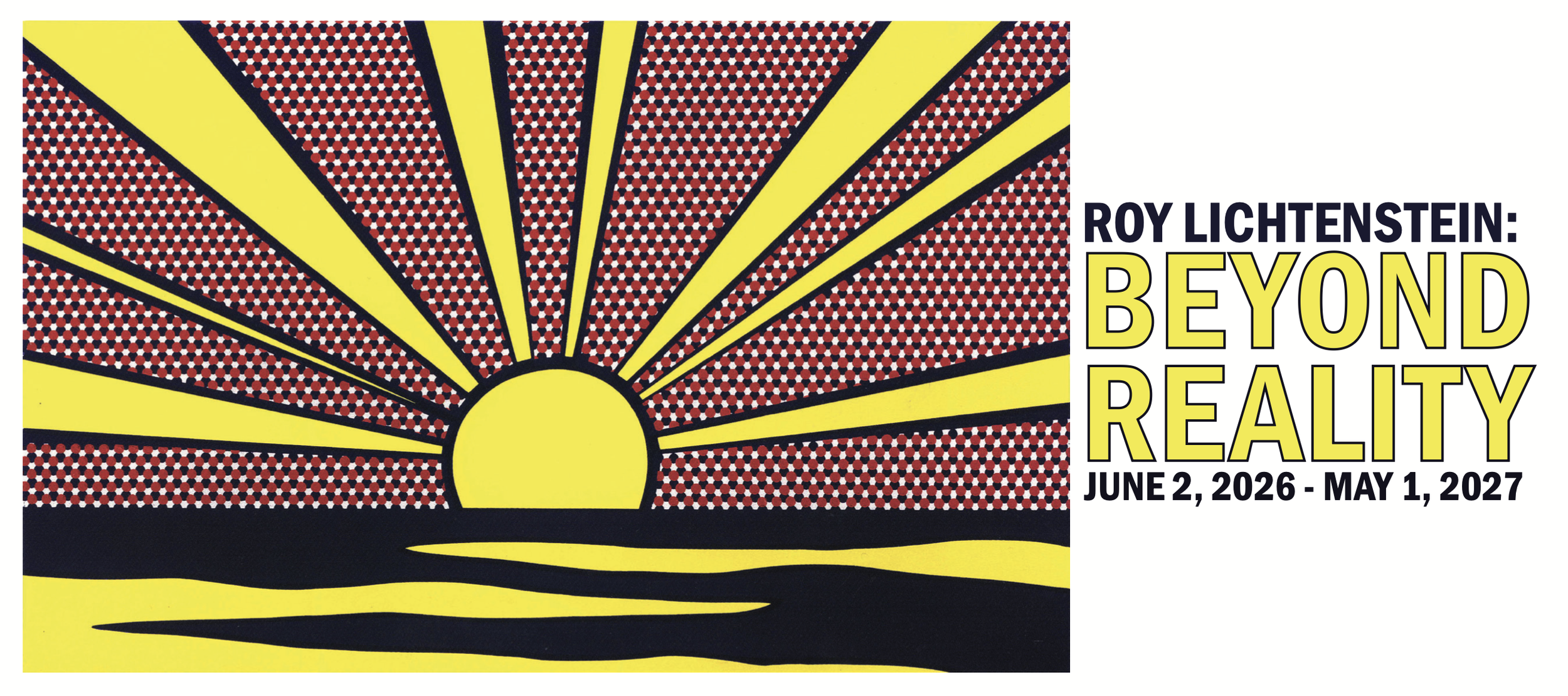
Join us on a journey to reconsider the familiar. Through bold outlines, vibrant fields of color, and patterned dots, Roy Lichtenstein conveys emotion with a distinctly mechanical style. A crying figure, a landscape, or a monumental cathedral are all treated the same. In doing so, Lichtenstein suggests that meaning is not fixed within an image, but shaped by scale, context, and the act of looking. Roy Lichtenstein: Beyond Reality is not about escape, but about perception. Images do not reflect reality so much as shape it, and meaning exists in the space between image and viewer.

Roy Lichtenstein is one of the most recognizable figures of the Pop Art movement, best known for his signature comic book style and use of Benday Dots. His bold compositions drew on advertising, romance comics, and commercial imagery, elevating everyday visuals into fine art. Like many of his Pop contemporaries, Lichtenstein sought to challenge distinctions between “high” and “low” culture, while also exploring themes of consumerism, war, and American iconography.
Born in New York City, Lichtenstein was immersed in arts and culture from an early age. He served in World War II before returning home to launch his career. By the 1960s, he had joined Leo Castelli’s influential gallery and was exhibiting widely. It was through Castelli that Lichtenstein met John and Kimiko Powers, beginning a lasting friendship built on mutual respect and shared passions.
Lichtenstein and John Powers bonded over jazz and the saxophone. Powers, a dedicated player himself, encouraged Lichtenstein to revisit the instrument. That spirit of play and rhythm is reflected in Lichtenstein’s design for the first Aspen Jazz Festival poster, a commission that blended his artistic style with the improvisational energy of jazz.
In 1967, Lichtenstein participated in the inaugural residency at the Aspen Center for Contemporary Art, spearheaded by Powers. He spent the summer creating in the program’s studio, helping to establish Aspen as a serious site for contemporary art.
The Powers collection includes Still Life (1968), a striking screenprint on aluminum that fuses Cubism, Art Deco, and comic book aesthetics, a hallmark of Lichtenstein’s genre-defining legacy.
View more works by Roy Lichtenstein in Roy Lichtenstein: Beyond Reality, open June 2nd, 2026 to May 2nd, 2027.
Read more about our museum and the exhibition on Bloomberg Connects:
About Roy Lichtenstein
(1923–1997)
-
Sunrise, 1964 © 2026 Estate of Roy Lichtenstein/DACS.